On 13 October 2026, coinciding with the 37th International Day for Disaster Risk Reduction (IDDRR), the International Panel of Mesoscience held a session of its Mesoscience Applications and Practice Series (MAPS) , titled “Before and After Catastrophe: Living with a Changing Mountain”, at the Melbourne Innovation Centre in Australia. The session featured a keynote lecture by Professor Antoinette Tordesillas of the School of Mathematics and Statistics and the Centre for Disaster Management and Public Safety, The University of Melbourne, and was jointly hosted by Prof. Tordesillas and Dr. Nan Zhang, Executive Secretary-General of International Panel of Mesoscience (IPM). Held in a hybrid format, the symposium brought together researchers and disaster management practitioners from Australia, China, Nepal and other countries.
The lecture took the village of Kimtang in Nuwakot, central Nepal, as its case study. The 2015 earthquake triggered a catastrophic landslide that cost the village its homes and farmland, after which the community was relocated as a whole to a new settlement. Satellite observations, however, show that the risk did not disappear with relocation — it moved with it. Relocation reorganized the spatiotemporal organization of the entire coupled human–mountain system. The debris flow disaster on the China–Nepal border on 26 August 2026 has made this question all the more urgent. This transboundary disaster chain demonstrates once again that mountain hazard risk is not confined by national borders: the monitoring and response of any single country can hardly cover the full chain of such a disaster, and international cooperation therefore plays an ihheplaceable role in disaster risk governance.
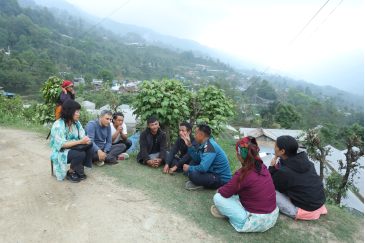
Prof. Tordesillas noted that Kimtang is a prototypical coupled human–mountain complex system, in which slope deformation, domestic water use, agricultural production, roads and settlements interact continuously. The dynamic operating state that results can be described as a “mesoregime” — disaster risk persists, yet everyday life remains viable. Drawing on Sentinel-1 ground motion data spanning 2019 to 2026, the team identified how risk shifted across the village over time, together with a persistent meso-structure, M(t).
At the technical level, the team extended the “GEneric DYnamics - GEDYs” of precursory failure in particles from laboratory research to an entire mountain. Displacement vectors are mapped into an abstract state space that encodes motion alone, and each point is scored according to how anomalous its motion is relative to its neighbours. The most unusual points trace out the path of the crack before the crack itself forms. This signature holds robustly across sand, glass beads, concrete, rock and other materials, and has been verified at the satellite scale.
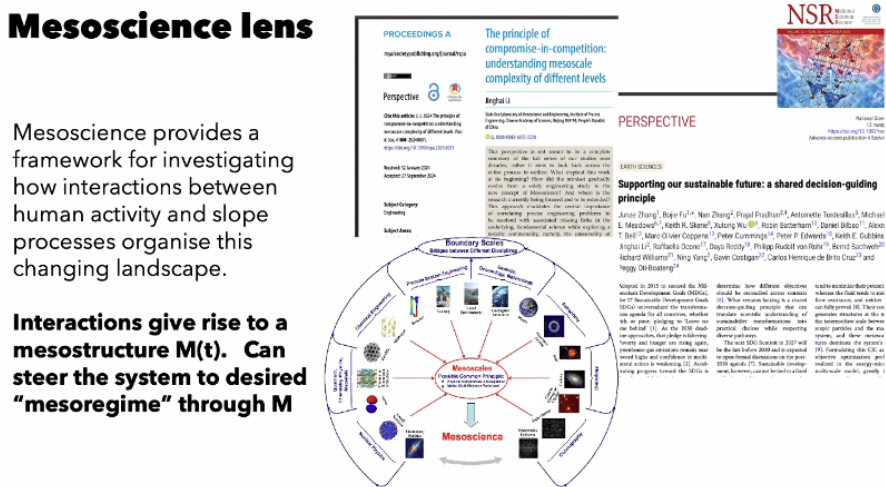
Mesoscience provided the theoretical framework for understanding the above. The lecture noted that within a multi-factor coupled system there exists a trade-off of “compromise-in-competition”, from which an emergent meso-structure can be quantified. Once this mechanism is understood and mastered, it becomes possible to better understand the coupled human–mountain complex system as a whole, and to offer a scientific pathway for disaster risk governance and sustainable development.
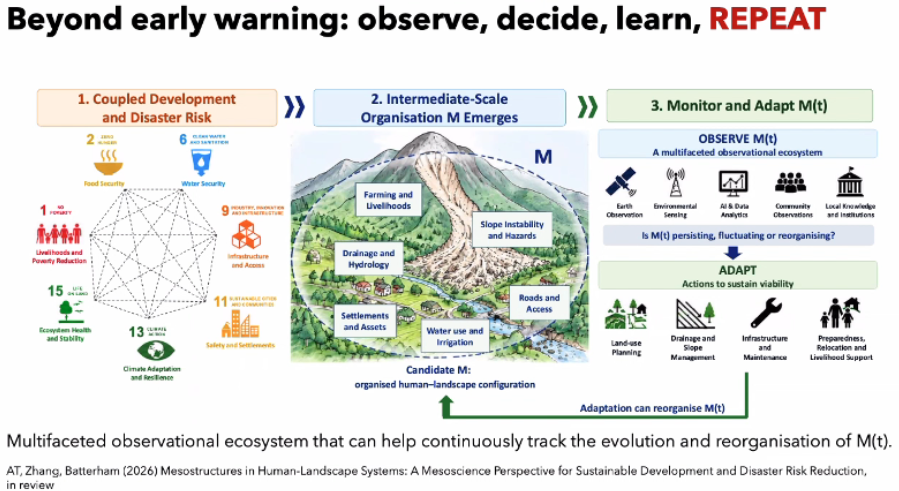
In closing, the lecture showed that the object of early warning needs to be broadened from “disaster risk as such” to “how the coupling between development decisions and disaster risk evolves over time”, forming a closed loop of “observe, decide, learn, repeat” and integrating continuous monitoring with local community observation.
Coinciding with this year’s IDDRR — under the theme “Building Safe and Resilient Homes” — the question the lecture posed, how communities can continue to live safely in the presence of persistent risk, offers a scientific footnote to that theme drawn from the Himalayan mountains. The answer to that question plainly requires scientific collaboration, data sharing and community engagement that transcend national borders. As this symposium demonstrated, international cooperation is not only a practical necessity for disaster risk governance, but the very path towards building safe and resilient homes.
The Mesoscience Applications and Practice Series (MAPS) will continue in the near future, fostering interdisciplinary dialogue and advancing research on applying mesoscience to global challenges, including disaster risk governance and sustainable development.
Drafted by Jianyun Zhu
Edited by Yuansan Liu
Confirmed by Antoinette Tordesillas, Nan Zhang